
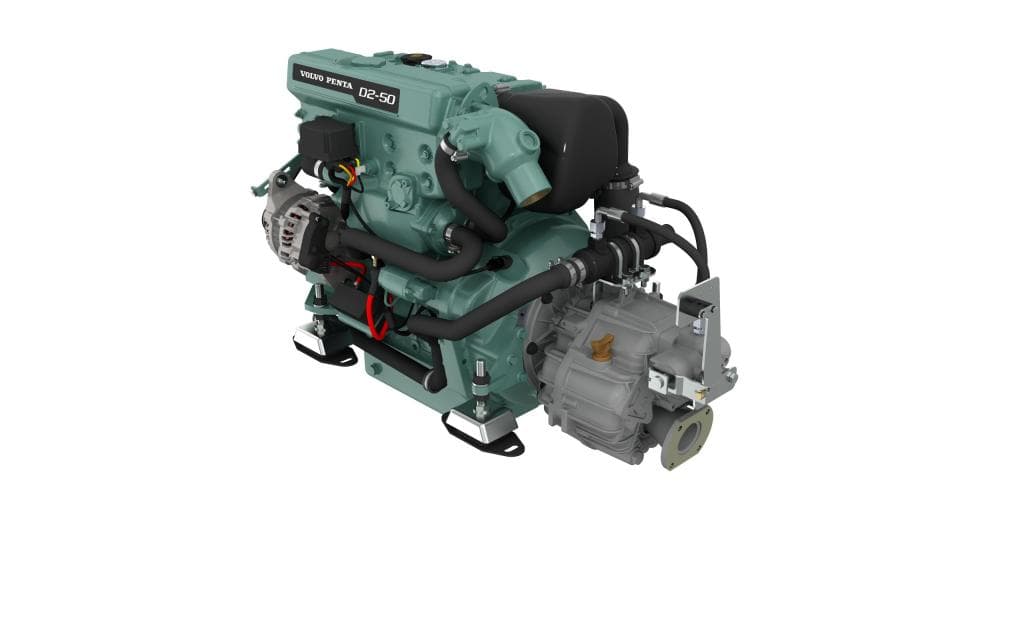
Volvo Penta D2 · Authorised dealer · Melbourne
Volvo Penta D2 service, brought to your berth.
On a saildrive or a shaft, from the D2-40 to the D2-75. Serviced to Volvo Penta’s schedule by an authorised dealer, with a clear rundown of what’s urgent and what can wait.
- Authorised Volvo Penta dealer
- Servicing Melbourne boats since 1995
- Genuine Volvo Penta parts
- At your berth across Port Phillip Bay
Your setup
Which D2 setup do you have?
The D2 is fitted one of two ways, and each drive has its own service needs alongside the engine. Pick yours to see what we look after.
Most D2-powered yachts drive a Volvo Penta saildrive: the 130S behind the D2-40, D2-50 and D2-55, and the bigger 150S behind the D2-60 and D2-75. The leg has its own oil, anodes and rubber seal.
- Engine oil and filter, genuine Volvo Penta
- Fuel filter, pre-filter and bleed
- Seawater pump impeller
- Saildrive oil change, checked for water
- Drive and propeller anodes at haul-out
- Folding propeller cleaned and greased
- Rubber seal inspection, renewed on schedule
- Heat exchanger and coolant on schedule
What you get
You’ll know exactly where your engine stands.
Every service ends with a plain-English rundown. Each item is marked done, keep an eye on, or needs attention, so you can see what’s urgent and what can wait. Anything beyond the service is quoted first.
- A record for the engine and its drive, every visit
- Kept for your warranty and resale history
- What’s due next, so you can plan around the season
Servicing and your Volvo Penta warranty
Volvo Penta’s leisure warranty expects your engine to be maintained to the operator’s manual, with records kept, and excludes faults caused by non-genuine parts or by repair work done outside Volvo Penta’s authorised network. On older D2s, Volvo Penta’s Extended Protection for leisure boats also required the scheduled services to be done by an authorised dealer or workshop. Your warranty documents set out the terms for your engine. We service to the schedule with genuine parts and record every visit. Your rights under the Australian Consumer Law apply in addition to these terms.
Service rundown
D2-55 · Shaft · 1,900 hours
- Done
Engine oil and filter
- Done
Fuel filter and pre-filter
- Done
Seawater pump impeller
Replaced. Vanes had taken a set.
- Done
Reverse gear oil
Changed. Clean.
- Done
Engine mounts and alignment
Checked. No change.
- Keep an eye on
Heat exchanger
Light scale. Clean at the next service, when the coolant is due.
- Done
Alternator belt
Tension adjusted.
- Needs attention
Shaft seal
Past Volvo Penta’s five-year interval. Quoted for the next haul-out.
Something not right?
Signs your D2 wants attention.
Many problems give a warning first. If you’ve noticed one of these, it’s worth a look before it turns into a lost weekend.
A coolant temperature alarm
Volvo Penta’s list of causes runs from low coolant and a blocked seawater intake or filter to a slipping belt, a failed impeller or a faulty thermostat. On a saildrive, the seawater comes in through the leg.
The oil pressure light comes on
Volvo Penta warns that running on with low oil pressure causes serious engine damage. Check the oil level, and if the light stays on, have it looked at before you run the engine again.
Grey or milky saildrive oil
Volvo Penta’s manual says grey oil means water has got into the drive. Get it looked at before the gears suffer.
Won’t start, or stops on its own
Volvo Penta’s fault list covers lack of fuel, air or water in the fuel and a blocked air filter when the engine won’t start, and a flat battery or poor connection when it won’t turn over. On later D2s, Volvo Penta has also documented faults in the MDI, the electronic box between the engine and the control panel, that can stop the engine starting or stop it suddenly.
Smoke you haven’t seen before
Volvo Penta links black smoke to not enough air, poor preheating, running too cold or the wrong propeller. Blue or white smoke can mean the engine is running too cold or the oil level is too high.
Won’t reach full rpm
Volvo Penta’s list includes a fouled hull, drive or propeller, a blocked air filter, air or water in the fuel, and a damaged or wrong propeller.
Timing
Book around the boating season.
A little planning means the boat is ready on the first good sailing weekend, not the third.
78%
of maritime incidents reported in Victoria in 2024–25 were vessel breakdowns, most of them engine failure or running out of fuel.
Source: Safe Transport VictoriaAugust to October
Pre-season service
Book before the rush. November to Easter is our busiest period, so a service in late winter or early spring has the boat ready for the first good weekend.
Book a pre-season serviceNovember to Easter
On the water
Peak sailing, and our busiest months. If an alarm won’t clear or something doesn’t feel right mid-season, call us.
Easter to July
Bigger jobs
The best time for haul-outs, saildrive seals, shaft seals and propeller work, with the least sailing missed.
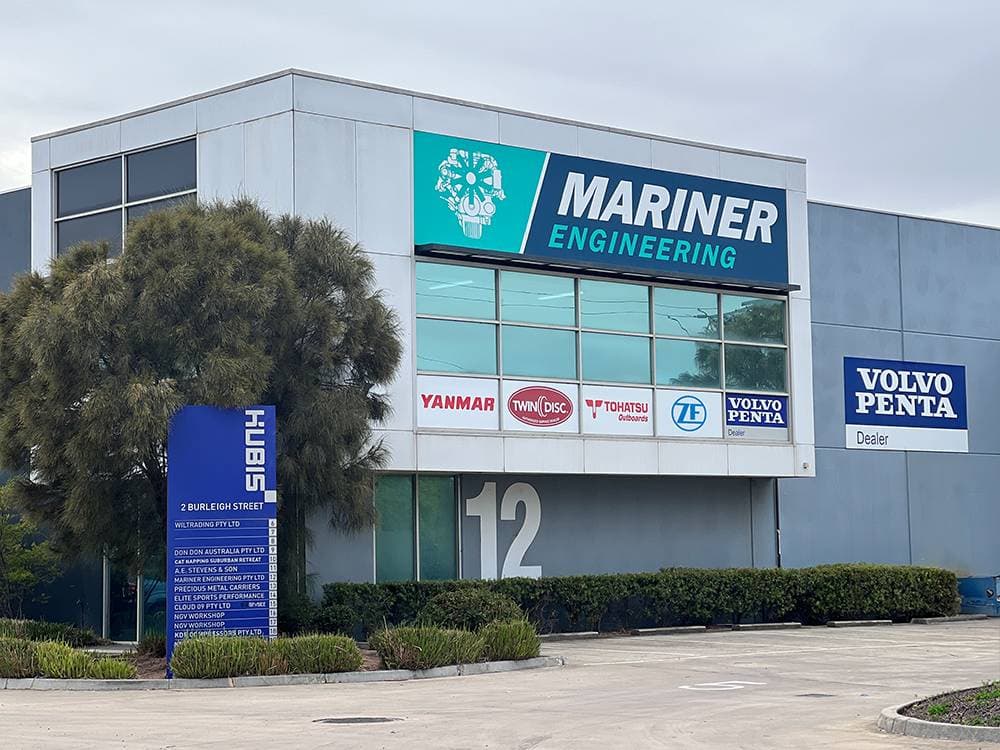
Who you're dealing with
An authorised Volvo Penta dealer, looking after Melbourne boats since 1995.
Our technicians bring Volvo Penta’s service procedures, specifications and special tools, and genuine D2 service parts, to your berth. Bigger jobs come back to our Spotswood workshop.
- Authorised Volvo Penta dealer
- Factory-trained technicians
- Genuine Volvo Penta parts on the shelf
- Also authorised for Yanmar and Twin Disc, and a ZF Marine Service Point
Every D2, old and new
Check the full designation on the engine plate when you book. The D2-55 arrived in the early 2000s and the D2-75 in 2003, and the letter on the end of the designation (D2-55E or D2-75F, for example) marks the version. The saildrive or gearbox has its own plate too.
D2s were fitted, as standard or as an option, to boats like the Bavaria 38, 39 and 46 Cruiser, Bavaria 42, Dehler 41 and 44, Beneteau First 44.7, Hanse 505, Dufour Grand Large 460 and Hallberg-Rassy 40. Some hulls were built with a different engine, so check the plate.
Questions
What D2 owners ask us
How much does a D2 service cost?
It depends on your model, whether it’s on a saildrive or a shaft, and what’s due on your engine’s schedule. We confirm all of that and give you a clear quote before any work starts.
Do I need to bring the boat to you?
No. We service D2s at their berth or on the hardstand around Port Phillip Bay. Saildrive seals, anodes, shaft seals and propeller work need the boat out of the water, so we plan those around a haul-out.
How often does a D2 need servicing?
On the D2-40, D2-55 and D2-75, Volvo Penta’s schedule has the engine oil and filter, fuel filters and an impeller check every 500 hours or 12 months, whichever comes first. The saildrive or reverse gear oil is changed every 200 hours or 12 months, coolant and the heat exchanger every 500 hours or two years, and the saildrive’s rubber seal every seven years. Newer engines follow Volvo Penta’s current service protocol, so we work to your engine’s own schedule.
Will servicing with you keep my Volvo Penta warranty valid?
Volvo Penta’s leisure warranty expects maintenance to your operator’s manual with records kept, and excludes damage from non-genuine parts or repairs outside its authorised network. As an authorised Volvo Penta dealer we service to the schedule with genuine parts and record every visit.
Which D2 do I have?
The model is on the engine plate, for example D2-40 or D2-75. The full designation ends in a letter that marks the version, such as D2-55E, so send us that and the saildrive or gearbox plate details and we’ll know exactly what you have. If your plate says MD2040 or MD22, you have one of the earlier MD-series engines.
Can you replace the saildrive seal?
Yes. Volvo Penta says the rubber seal between the saildrive and the hull should be changed every seven years, or sooner if it’s damaged, at an authorised workshop. It’s an out-of-water job, so we plan it with your haul-out and look at the anodes, propeller and leg oil while the boat is out.
How do I book?
Use the booking form at the top of this page or call (03) 9399 5888. We aim to reply within 1 business day.
Ready when the weather is.
Tell us about your D2 and where the boat is, and we’ll take it from there.