
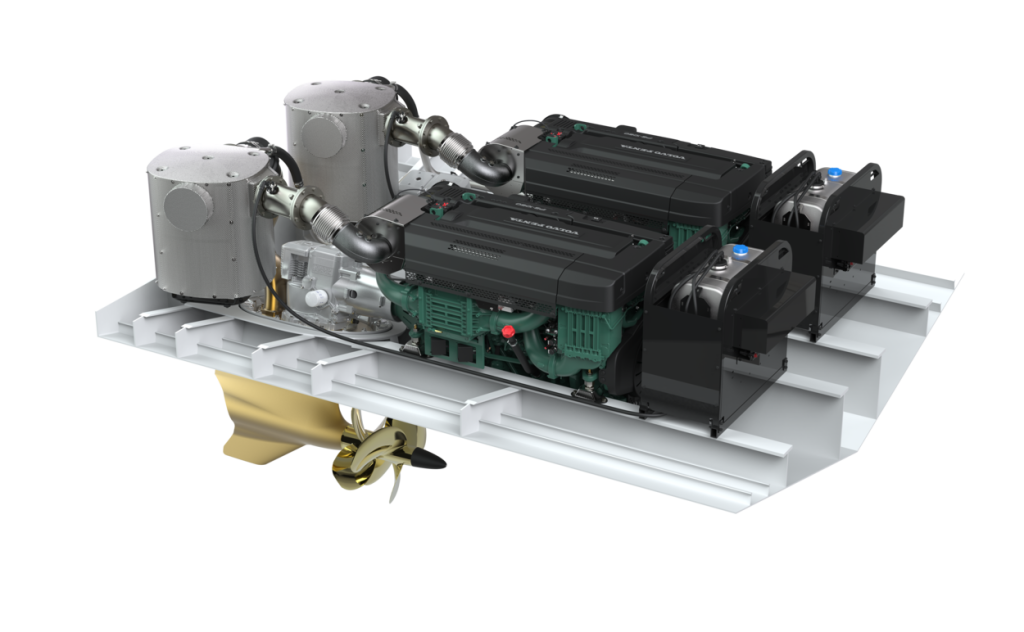
Volvo Penta IPS is a complete, factory-integrated propulsion package: an electronically controlled diesel engine, a steerable pod drive with twin forward-facing counter-rotating propellers, underwater exhaust, and fully electronic vessel control from helm to prop. Because the propellers pull the boat through undisturbed water ahead of the pod rather than pushing from behind, IPS converts more of the engine's output into thrust. Compared with a similar inboard shaft installation, Volvo Penta's published figures are up to 30% lower fuel consumption, around 40% longer cruising range, up to 20% higher top speed and roughly 50% less perceived noise — results vary with hull and installation, but those gains are why IPS has become the most widely adopted pod system on modern motor yachts.
The range we supply spans four engine platforms, each matched to its own pod size. The 5.5-litre six-cylinder D6 covers the D6-IPS400, D6-IPS500 and D6-IPS650, running Volvo Penta's smallest pod — the IPS10 unit in current-generation packages, with earlier versions of the same pod line under older D6 models. The 7.7-litre D8 pairs with the larger IPS15 pod as the D8-IPS800, the 10.8-litre D11 with EMS engine management drives the IPS20 pod as the D11-IPS950, and the 12.8-litre D13, also with EMS, turns the big IPS30 pod as the D13-IPS1350. In Volvo Penta's naming convention the model number reflects the performance level you would expect from a conventional inboard of that horsepower — so a D6-IPS650 installation is sized to perform like a 650 hp shaft-drive setup while burning meaningfully less fuel.
The IPS range
The right IPS package is set by your hull, displacement and target cruising speed rather than horsepower alone, and installations are engineered with Volvo Penta's sizing process — but as a rough guide, twin D6-IPS400 to D6-IPS650 installations suit flybridge and sports cruisers up to around 55 feet, the D8-IPS800 steps up for larger or heavier hulls, and the D11-IPS950 and D13-IPS1350 carry big yachts from roughly 60 feet up to around 120 feet in twin, triple or quad configurations. If you're specifying a new build or replacing engines in an existing IPS boat, we can work through the sizing with you against Volvo Penta's recommendations for your hull.
D6-IPS400
300 HP6-cylinder · 5.5L · Common rail direct injection
View engineD6-IPS500
380 HP6-cylinder · 5.5L · Common rail direct injection
View engineD6-IPS650
480 HP6-cylinder · 5.5L · Common rail direct injection
View engineD8-IPS800
600 HP6-cylinder · 7.7L · Common rail direct injection
View engineD11-IPS950
725 HP6-cylinder · 10.8L · Electronic high-pressure unit injectors with EMS engine management
View engineD13-IPS1350
1000 HP6-cylinder · 12.8L · Electronic high-pressure unit injectors with EMS engine management
View engineDrive options
IPS10 pod
Volvo Penta's smallest pod, matched to the D6 engines — twin forward-facing counter-rotating props, steerable pod and underwater exhaust for boats typically in the 35–55 ft range. Current packages such as the D6-IPS650 run the IPS10 unit; earlier D6-IPS400 and D6-IPS500 packages used previous versions of the same pod line, which we service and support.
IPS15 pod
The heavier-duty pod behind the D8-IPS800, stepping up thrust capacity for larger and heavier hulls — usually as twins, with triple installations on some designs.
IPS20 pod
Paired with the D11-IPS950 for big flybridge and sport yachts, typically in twin or triple installations.
IPS30 pod
The largest pod in this range, matched to the D13-IPS1350 — the flagship package here, carrying yachts up to around 120 feet in twin, triple or quad fit-outs.
Boats this family suits
Pricing, repower advice or a spec for your boat
Tell us your vessel and how you use it — we'll recommend the right model and drive, with dealer pricing.
Why buy your IPS from Mariner
Pulls, doesn't push
Forward-facing counter-rotating propellers work in clean, undisturbed water ahead of the pod, with thrust parallel to the hull. That's the basis for Volvo Penta's published gains over a comparable shaft installation — up to 30% better fuel economy, around 40% more range and roughly half the perceived noise.
Joystick handling and dynamic positioning
Individually steerable pods give IPS boats close-quarters manoeuvrability no shaft boat can match. Joystick docking is the signature of the system, and Volvo Penta's optional Dynamic Positioning System holds the boat on station automatically — genuinely useful waiting for a berth or rigging lines.
Authorised IPS support on Port Phillip Bay
IPS rewards proper factory-backed servicing. Our Spotswood workshop has factory-trained Volvo Penta technicians, genuine parts and the diagnostic tooling for EVC, EMS 2 and pod servicing — from scheduled maintenance to full engine changeovers with sea-trial commissioning.
Volvo Penta IPS — your questions answered
Which IPS model does my boat need?
It depends on hull length, displacement and the cruising speed you want, and Volvo Penta engineers each IPS installation to the specific hull. As a broad guide, twin D6-IPS packages (IPS400–IPS650) cover most boats up to around 55 ft, the D8-IPS800 suits larger or heavier hulls, and the D11-IPS950 and D13-IPS1350 power big yachts in twin, triple or quad installations. Bring us your boat's details and we'll match the options against Volvo Penta's sizing recommendations.
Can I repower my shaft-drive boat with IPS?
Honestly, in most cases no. IPS requires a hull engineered around the pods from the outset — structural mounting, weight distribution and pod placement are all designed in at the build stage — so converting a conventional shaft boat is rarely practical or economic. If your boat already runs IPS, replacing tired engines or upgrading within the family is well-proven work we handle regularly. For shaft-drive boats, a Volvo Penta D4, D6 or D8 shaft repower is usually the better path, and we can quote both ways.
Why choose IPS over a conventional shaft installation?
Efficiency and handling. Volvo Penta's published figures against a comparable shaft installation are up to 30% lower fuel consumption, around 40% longer range, up to 20% higher top speed and about 50% less perceived noise, though results vary by hull. On top of that you get joystick docking, optional dynamic positioning and more usable interior space because the engines sit further aft. The trade-off is that IPS suits boats designed for it, and the pods add their own servicing schedule.
How is IPS serviced in Melbourne, and is it expensive to maintain?
IPS needs disciplined scheduled servicing — engine service items plus pod oil changes, propeller and anode checks and seal inspections to Volvo Penta's intervals — and skipping it is false economy on a system like this. As an authorised Volvo Penta dealer in Spotswood, we service IPS with factory-trained technicians, genuine parts and current diagnostic software, and we support boats right across Port Phillip Bay. Maintained on schedule, IPS has a long, well-documented service record.
Ask about the IPS range
Tell us your vessel, how you use it, and whether this is a new build or a repower — our team will recommend the right Volvo Penta IPS model and drive, with pricing, usually within 1 business day.