
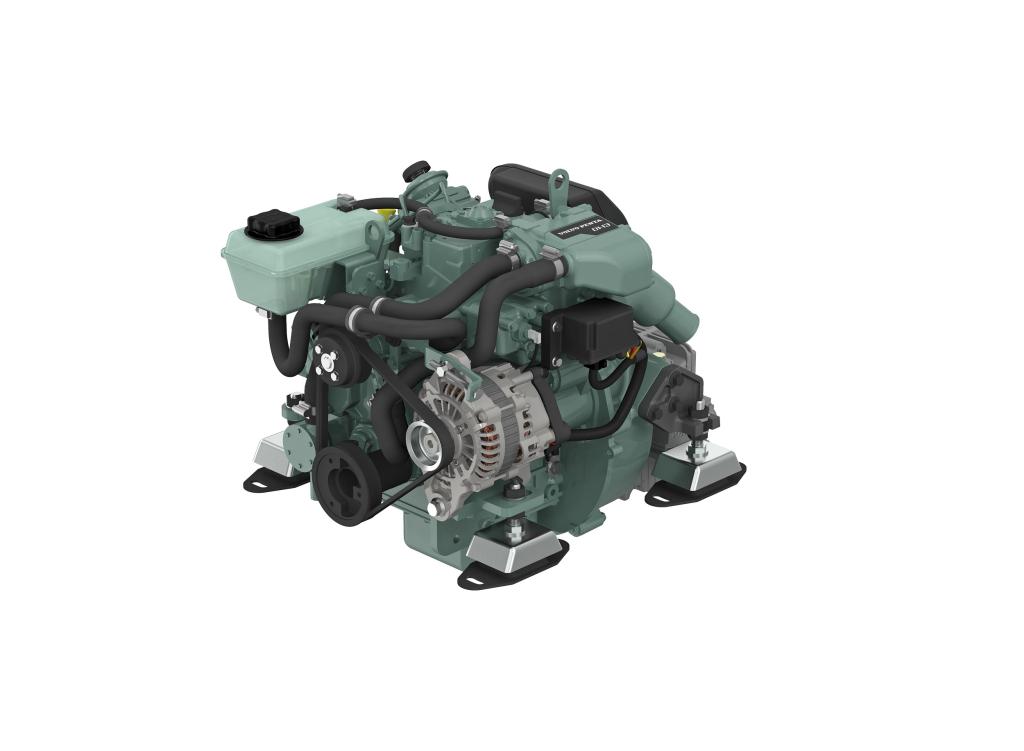
The D1 series is the entry point to Volvo Penta's marine diesel range: compact, naturally aspirated engines spanning 12 to 27 hp at the crankshaft. The family runs from the two-cylinder, 0.5-litre D1-13 through the three-cylinder D1-20 (0.8 litres) to the three-cylinder, 1.1-litre D1-30. All three use a simple cam-driven, in-line mechanical injection pump, and freshwater (heat-exchanger) cooling is standard — a deliberate recipe for reliability in an engine that may sit unused for weeks and then be asked to start first time.
The character of the family is unmistakably sail-focused. These engines are tuned for low cruising revs, quiet running and minimal vibration, with good torque low in the rev range for manoeuvring in a marina pen or punching into a headwind. Because the fuel system is fully mechanical, there is no common-rail electronics package to diagnose — a genuine advantage on a boat that lives on a swing mooring or heads down the bay for a week. A high-output 115 A alternator comes standard, which is unusually generous at this size and a real asset for cruising yachts running fridges, instruments and autopilots.
The D1 range
The split across the family is fairly clean. The two-cylinder D1-13 suits light-displacement yachts and trailer-sailers, roughly up to the mid-20-foot range; the D1-20 adds a third cylinder and covers most small cruising yachts; and the 1.1-litre D1-30 is the pick for heavier or higher-windage boats up to around 35 ft, and for displacement launches that motor more than they sail. Those lengths are only a guide — displacement, propeller and how the boat is actually used matter more, and Port Phillip's short chop rewards having a margin in hand, which is why repowering owners often step up one model over the engine coming out. Tell us the vessel and the engine it currently carries and we can size it properly.
Drive options
130S saildrive
All three D1 models are offered as a fully integrated package with Volvo Penta's 130S saildrive — engine, leg and folding-prop options matched at the factory. The most common configuration for modern production yachts and saildrive repowers.
Shaft drive (inboard)
Conventional shaft installations pair the D1 with Volvo Penta's MS15 mechanical gearbox — MS15A with an 8° down-angle output or MS15L with a straight output — with ratio options to suit the hull and propeller. The straightforward choice when repowering an existing shaft-drive yacht or launch.
Boats this family suits
Pricing, repower advice or a spec for your boat
Tell us your vessel and how you use it — we'll recommend the right model and drive, with dealer pricing.
Why buy your D1 from Mariner
Simple, quiet and sail-friendly
Naturally aspirated engines with mechanical in-line injection and standard freshwater cooling — low vibration, low cruising revs, and nothing electronic in the fuel system to trouble-shoot at sea.
Serious charging for a small engine
A 115 A alternator is standard across the family, so even the D1-13 can keep house batteries, fridges and instruments topped up — a spec normally associated with much larger engines.
Dealer repowers, done properly
As Melbourne's authorised Volvo Penta dealer we assess your beds, shaft or saildrive aperture and exhaust before quoting, then install, commission and sea-trial the new engine ourselves from Spotswood, with factory-trained servicing and genuine parts afterwards.
Volvo Penta D1 — your questions answered
Which D1 model does my boat need?
As a rough guide: D1-13 for light yachts and trailer-sailers, D1-20 for most small cruisers, D1-30 for heavier boats up to about 35 ft or displacement launches. But the honest answer depends on displacement, windage and your propeller — if you're replacing an existing engine, the outgoing model and prop tell us most of what we need. Send through the vessel details and we'll recommend a model rather than guess.
Can a D1 replace my old Volvo MD or 2000-series engine?
In most cases, yes — the D1 range is the standard modern replacement for those engines and this is one of the most common repowers we do. Engine beds, shaft coupling or saildrive interface, exhaust and instrument wiring all need checking, and some adaptation is normal on older installations. We quote it as a complete changeover: removal, installation, new panel and loom, and sea-trial commissioning.
Saildrive or shaft — which should I choose?
Usually the boat decides for you. If it already has a saildrive, a D1 with the 130S leg is the clean path; if it's shaft-driven, stay with shaft and the MS15 gearbox. Converting from one to the other means structural work that is rarely worth the cost on boats this size. If you're replacing an older Volvo saildrive leg, we'll assess what's involved before quoting — it isn't always a straight swap.
What does servicing involve?
Very little, which is part of the appeal. These are simple mechanical diesels: routine oil and filter changes, impeller, anodes and coolant, plus the saildrive-specific items — leg oil and the rubber diaphragm seal, which Volvo Penta requires to be replaced at a set interval. We service D1s with factory-trained technicians and genuine parts, in our Spotswood workshop or mobile to your boat at marinas and moorings around Port Phillip Bay.
Ask about the D1 range
Tell us your vessel, how you use it, and whether this is a new build or a repower — our team will recommend the right Volvo Penta D1 model and drive, with pricing, usually within 1 business day.